Showing posts with label silver. Show all posts

Wednesday, September 11, 2013

Silver: Precious Metal With The Highest Thermal And Electrical Conductivity


Silver: Precious Metal With The Highest Thermal And Electrical Conductivity

Silver is generally described as a soft, white, lustrous metallic chemical element. It occurs naturally in its pure form, as an alloy with other metallic elements (especially gold), and in chlorargyrite and other minerals. As one of three coinage metals (the other two being copper and gold), silver is very malleable and ductile.

Of the different metals, silver is known to have the highest thermal conductivity. Similarly of the different known elements, silver has the highest electrical conductivity. Provided below are some of the properties of this precious metal.

General:


• Chemical Symbol: Ag

• Atomic Number: 47

• Category (as an element): Transition Metal

• Group/ Period/ Block (in the Periodic Table): 11/ 5/ d

• Atomic Weight: 107.8682 g.mol-1

• Electron Configuration: [Kr] 4d10 5s1

Physical:


• Density (near room temperature): 10.49 g.cm-3

• Liquid Density (at melting point): 9.320 g.cm-3

• Melting Point: 961.78°C, 1234.93°F, 2041.4°K

• Boiling Point: 2162°C, 3924°F, 2435°K

• Heat of Fusion: 11.28 kJ.mol-1

• Heat of Vaporization: 250.58 kJ.mol-1

Atomic:


• Oxidation States: 1, 2, 3

• Electronegativity: 1.93 (Pauling scale)

• Atomic Radius: 144 picometre

• Covalent Radius: 145±5 picometre

• Van der Waals Radius: 172 picometre

• Ionization Energies: 731 kJ.mol-1 (first), 2070 kJ.mol-1 (second), 3361 kJ.mol-1 (third)

Despite having higher electrical conductivity than copper, silver isn't as much used for electrical purposes as copper is. There are two reasons for this: first is that silver has a greater tendency to tarnish; and second is that silver is much more expensive.

As a precious metal, silver has been much valued for ages with its so many applications, as in the following:

1. Jewelry (sterling silver is used in making fine jewelry and watches).

2. Silverware (sterling silver is also used in making utensils, tableware and ornaments).

3. Photography (silver nitrate and silver halides are used in making films).

4. Electrical and electronic products (silver paints are used in making printed circuits; silver electrical contacts are used in making computer keyboards).

5. Dentistry (silver-mercury alloy is used in making dental amalgams).

6. Optics and mirrors.

7. Various industrial and commercial uses (silver is ideal for use as a catalyst in chemical reactions).

8. Clothing (silver ions are mixed with the polymer to make yarns).

9. Medicine (silver compounds and silver ions have toxic effect on some viruses, fungi and bacteria, but not on humans).

10. Currency or coinage (as in silver bullion).

The principal sources of silver are copper, lead, zinc and gold ores. It also occurs in the minerals chlorargyrite and argentite. Of course, silver occurs natively, too. Some of the top silver-producing countries in the world are the United States, Canada, Peru, and Mexico. Fine silver, which has no less than 99.9% silver, is available commercially.

Because of competing store-of-value and industrial demands, the price of silver has fluctuated considerably over the last century. As of the beginning of 2010, the price of this precious metal is estimated at about 18 U.S. dollars per troy ounce (or 588 U.S. dollars per kilogram). You can find even more detailed information about silver from Hubpages.

Tuesday, September 10, 2013

Silver As An Investment


Silver As An Investment: Ways Of Investing In Silver

Silver is like three other precious metals (gold, palladium, and platinum) in terms of being regarded as an investment commodity. In fact, this precious metal has been regarded as a form of currency and a store of value for over four centuries.

There are different ways of investing in silver. Six are presented here:

Buying silver coins:


This is a popular way of taking hold of silver - physically. Perhaps the best example of a silver coin is the Canadian Silver Maple Leaf, which consists of 99.99% pure silver. Silver coins may either be "fine silver" or "junk silver". Junk silver coins are older coins with a lower percentage of silver. Examples of these are the dime, quarter, and fifty-cent U.S. coins minted in 1964 or earlier. These coins contain 90% silver and are 8/10 troy ounce per 1 USD of face value.

Buying silver bullion bars:


This is the most traditional way of investing in silver. Silver bullion bars can be bought or sold over the counter in most banks in Switzerland. They may be stored in safe deposit boxes in banks or placed in non-fungible (allocated) or pooled (unallocated) storage with a silver dealer.

Opening a silver account:


An investor may open a silver account with one of the major banks in Switzerland. Here, silver can be bought or sold over the counter just like any foreign currency. However, the bank client does not own the actual silver metal. Instead, he/she has a claim against the bank for a specified quantity of the metal. A silver account is backed through either allocated or unallocated storage.

Owning a silver certificate:


In lieu of storing actual silver bullion, an investor may opt for ownership of a silver certificate. A silver certificate allows an investor to buy and sell the security sans the inconveniences associated with the physical silver's transfer. The Perth Mint Certificate Programme, which is fully guaranteed by the Government of Western Australia, is the only silver certificate program in the world that is guaranteed by a national government.

Trading in Exchange-Traded Funds (ETFs):


An investor can have an easy way of gaining exposure to the price of silver through an ETF. Some of the well-known ETFs include iShares Silver Trust (with ticker symbol NYSE: SLV), Central Fund of Canada (with ticker symbols TSX: CEF.NV.A, NYSE: CEF), and ETFS Silver Trust (with ticker symbol NYSE: SIVR). Trading in ETFs means doing away with the inconveniences associated with the handling of physical silver bars.

Entering in a Contract For Difference (CFD):


Some of the noted financial services firms, especially those in the United Kingdom, provide Contract for Difference (CFD). In this silver investment vehicle, two parties (a "buyer" and a "seller") enter into a contract, in which the seller agrees to pay the buyer the difference between the current value of silver and its value at contract time. In case the difference is negative, the seller receives payment instead from the buyer. A CFD, therefore, allows an investor to take advantage of long or short positions, enabling him/her to speculate on these markets.

It must be mentioned here though that silver has lost its forced tender status in the United States since the abandonment of the silver standard, when, on August 15, 1967, then U.S. President Lyndon B. Johnson announced that the U.S. would discontinue redeeming currency for silver (or any other precious metal). You can find even more detailed information about investing in silver from Hubpages.

Monday, September 9, 2013

Gold And Silver: The Two Precious Traditional Coinage Metals


Gold And Silver: The Two Precious Traditional Coinage Metals

Four transition metals make up group 11 of the periodic table of elements. All, except one, are considered traditional coinage metals. Qualifying this further, only two of these three traditional coinage metals are considered precious metals. These are gold and silver.

Gold and silver are rare and have high economic values. These things can't be said of copper, the other traditional coinage metal. Occurring in nature in metallic form, these two precious metals can be produced sans the use of extraction metallurgy.

Characteristics of gold and silver


These other characteristics make them both well suited for coinage:

• They are not radioactive.

• They are more ductile or softer than most other elements.

• They are less reactive compared with other elements.

• They have excellent luster.

• They have higher melting points compared with other metals.

The high-ductility property of gold and silver means they can be easily damaged as coins for circulation. Coins intended for circulation must be highly resistant to corrosion and wear. For this reason, gold or silver must be alloyed with other metals (example, manganese) so that the resulting coins will come out harder, more wear-resistant, and not easily damaged or deformed.

As numismatic items, gold and silver coins are made almost entirely of the precious metals, respectively. Current collectible gold coins (the 22-carat gold coins), for example, are made of 92% gold, with silver and copper comprising the rest. The coins in circulation in the United States prior to 1933 were made of 90% gold and 10% copper-silver combined. Canada's official gold bullion coin - The Canadian Gold Maple Leaf - is made of 99.999% gold; and so are these four other gold bullion coins:

1. British Britannia (with a face value of 100 pounds).

2. Chinese Gold Panda (with face values of 500, 200, 100, 50, and 25 Yuan).

3. Swiss Helvetia Head (with face values of 100, 20, and 10 Swiss francs).

4. Austrian Vienna Philharmonic (with face values of 100, 50, 25, and 10 euros).

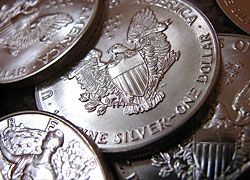
Silver coins, like the minted coins circulated in the United States and other countries prior to 1965, were made of 90% silver and 10% copper. The American Silver Eagle and the Mexican Silver Libertad bullion coins, introduced in 1986 and 1982 respectively, were made of 99.9% silver and 0.1% copper.

Other notable silver bullion coins include the Australian Silver Kookaburra, Chinese Silver Panda, and the Russian George the Victorious.

Minting coins, whether gold or silver, always entails the risk of having the value of the metal used in the coin greater than the coin's face value. This is especially true in coins of low denomination. Because of this, there exists the possibility of some smelters taking gold or silver coins and melting these down for the scrap value of the precious metals.

A couple examples, in this regard, are worth mentioning here: US pennies have been made of copper-clad zinc since 1982, when they were before this time made of copper alloys; and British pennies were once made of 97% copper, but are now made of copper-plated steel.

As additional information, gold and silver both have a currency code of ISO 4217. You can find even more detailed information about gold and silver from Hubpages.